Friday, March 13, 2015

Badlanders (1992) AKA Prison Planet


You know, the future gets away with a lot of shit. It's like the town psycho-kid, running around pulling the ears off bunnies and tacking them to your front door with a message scrawled in his poop about how he lost his grandmother's hair in your backyard. Everyone gives that kid, and the future-setting in books and movies, a wide-berth and mostly takes whatever it or he says or does as a product of its nature without question.

The future on other planets is even worse. It's like that psycho-kid's mom is some Whole Foods nut-job that only brings Paleo-Diet dishes to the Chicken Pox Party.

"Exactly what cave people ate...except for the cookware and the oven I cooked it in."


Meaning, it's one thing to be the kid spouting out nonsense and doing things that confuse and gross everyone out. But it's something else entirely to have the kid and his mom attend the first BBQ of the summer.

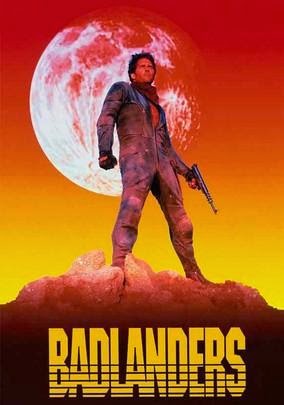
The same can be said for off-world, futuristic movies like Badlanders. The opener does that thing where a scrolling few paragraphs explains where we are and the situation we can expect as viewers. Short version? It's another world...in the future, bad things happen and there's an overthrown king. Or something. Doubtful you need more information than is provided in the title picture (top).

There's oppression.

We're escaping, or else I drop this thing! (Spoiler: he doesn't drop it)

There's some type of "wasteland." (Maybe it's the...Badlands. eh? eh?)

Scorched-earth places are SUPER popular in future movies...and doubly-so for space future movies. Apparently, so are cars?


There's swords.

Silly how swords are futuristic and historic and alien all at the same time.

And guns.

But not lazer* guns since bullets are just sound effects and don't require a VFX budget. (*90s spelling of laser intentional)


Leather vests and bare chests, but for some reason one guy is wearing a tie and a fedora.


And another guy sports a Spanish Conquistador hat.

Why not?

The movie wants to be Conan the Barbarian spiced up with some Mad Max with a hefty dose of Hell Comes to Frogtown as the main meat. But really, it's just boring. Boring like listening to someone relate the plot of this movie (of which I'll spare you since neither of us care). Although, that's not much of an analogy since it's the plot that makes this movie boring...

If the plot is what makes the movie boring, and relating the plot would be twice as boring. This.

Rather, it's mind-numbing...like reading about how cardboard is made while French-kissing sandpaper, or listening to someone tell you about the dream they had last night.

...and both my hands were sharks!!


It takes so much effort to maintain your attention to what's happening, let alone put it into some line of a plot. I mean, when one event only follows from the previous because they both played on your television screen, it's really tough to torture yourself into connecting the series of occurrences that happen.


And back we come to the analogy of the neighborhood psycho-kid and his mom. He might light fires in your backyard. His mom might send him over with a pitcher of cucumber water to apologize. He might even wear clown make-up while jumping rope on the hood of your car as his mother applauds.

Don't look him in the eyes!

But you don't try to put all of these things together in any rational way! That would be completely fruitless, as is watching this movie for any sort of entertainment.

Badlanders is available on Netflix...if you're into that sort of thing.

Wednesday, February 25, 2015

The Star Wars Holiday Special (1978)


This thing has an almost mythological status. Most have heard of it in some capacity, but for those who haven't, here's the short version:

It's 1978. Star Wars made a lot of money at the box office that no one expected it to make. Someone (maybe George Lucas, maybe not) signed the rights over to a company that produced variety shows. And The Star Wars Holiday Special was birthed in all of its horrid, mind-achingly insane glory. Afterwards, like popping a chub at the Thanksgiving table, everyone quietly agreed that it had never happened. But this is the internet, and nothing disappears completely. Even if it was made almost 40 years ago.

After all, this thing is still around.


With the rumors of how badly this show made the audience want to pluck out their own eyes, and how it makes fans of Star Wars wish they could sand-blast part of their brains after seeing it, I had to watch. But what it did to my sense of reality can never be undone. Sadly, the best I can do after having seen this thing is walk you through it step-by-step. I'm hoping that this approach will help me piece together what I've witnessed, and that large chunk of my sanity that shattered along the way.

So, let's talk about the beginning. Things start off in less than promising fashion with Han Solo and Chewbacca heading back to Chewbacca's home planet for "Life Day" (which is really just Christmas without calling it that). There, we meet Chewbacca's family...because remember all those times you thought to yourself, "That hairy dude who only Han Solo can understand is pretty interesting, I wonder what his family is like." No? You never wondered that? Well, I can't imagine why not.

The Wookie "homestead."

Neither, apparently, could the people who put this thing together. Because it turns out, this "Wookie" family pantomimes their way through family arguments, conversations, or whatever the hell you'd call an eternity and a half of growling at one another and waiving their arms around.

Eventually, there's a holographic dance number on one of those tables C3P0 and Chewbacca play chess on in the Millenium Falcon (this is called fan-service). Your guess as to why this happens is as good as mine since...you know...all the "characters" do is grunt and growl at one another.

It's like some version of Cirque-de-Soliel as envisioned by whoever wrote that Willy Wonka tunnel speech.

"There's no Wookie way of knowing, where our sanity is going..."

Chewbacca's family is worried, so they Skype-dial Luke Skywalker.

Who....somehow, looks more like plastic than I remember.
 
And then, things keep going along on that path. Chewbacca's family Skype-dials up some variety scene. Something ridiculous happens (barely within the realm of "story"), and then on to the next. All of it Star Wars-themed in the barest sense of the word.

Take this scene of an Imperial "Lord Helmet" with Art Carney in a Han Solo vest as an example.

Art Carney...for those of you who don't know who I'm talking about...is the one in the hat

The Wookie family isn't too worried though, because there's a moment where Chewbacca's...urm, kitchen-person-wearing-an-apron partner figure (I mean, I don't KNOW if it's a male or a female or some other gender-identifier) watches a Bantha cooking show.

Yep, and this scene lasts for a full five minutes.

Finally, we get back to Han and Chewie. Or rather, we get back to them in a cardboard mock-up of the Falcon's cockpit with inter-cut shots from Star Wars as Tie Fighters attack.


Art Carney brings over some gifts because that's what you do on "Life Day" and then the old codger Wookie jumps into a virtual reality machine to watch some other culturally-prescient person from 1978.

Seriously, who IS this?? And why is she so....70s!?!?

And, again, we get a momentary appearance from an original cast member. Princess Leia Skypes in alongside C3P0 because she (along with everyone watching) is looking for Han and Chewbacca. Though, so is the Empire.

Blah, blah, blah...[insert Carrie Fisher drug reference].


There's also a Jefferson Starship musical number....because someone wanted to make this thing age terribly on top of all its other problems.

I swear, this isn't what it looks like.

The overall point here is that there's not a single bit of this show that is more than tangentially connected to Star Wars.

Those are the clothes alright, but that's where it stops.


Well, back to the "plot," I guess. That super-hairy-family is raided by the Empire. Of course, (because Lucas wants to make things for the children) the little one turns on his Skype-machine and tunes into a cartoon. Wait, what?!!!?!

Apparently, no one cares that the audience can't read "Wookie."


OH, GOD...It's suddenly a cartoon!! Because, that's cheaper. Let's be honest. I mean, the Wookie-family story structure really didn't hold things together half as well as that cocaine-minded producer imagined it would. And it's a good thing too because it gets us back to what makes Star Wars the Star Wars we know and love. That element of nostalgia (before he was nostalgia) is Boba Fett...as he beats his burden animal.

*THWACK* Boba Fett, ladies and gents!!

Mostly because our main characters needed to stay in "character stasis" until the next movie, this part of the Holiday Special focuses on Boba.

One more time...because this is the only part of this two hours that people won't talk about derisively forty years later.


So, anyways. Boba Fett, the bounty hunter, is searching for Han Solo. He dials up Darth Vader, just to fit him in for about 10 seconds. All this happens as that Wookie dude is watching on his Skype-machine-thing because the Empire is searching his treehouse home for signs of Chewbacca.

I guess they're searching because the Rebel Alliance blew up the Death Star in the first (FUCK YOU...the FIRST) Star Wars Movie? Seriously, I'm so confused at this point.

Anyway. The cartoon continues...horribly. I mean, there's stylized, and then there's Han Solo looking like this...

Style should not trump substance to this extent.

Afterwards, we're returned to that hairy-family. Mostly to question our sanity as the story is pantomimed out for the audience in terribly inexplicable bits and parts that are like something out of the worst improv comedy. Because it is not funny AND it doesn't make sense...but it only exists because some asshole said, "Oh, it's a 'galaxy far, far away' so we CAN DO ANYTHING and it'll be alright."

And by "anything," I mean include a scene on the Skype-thing with Maude running a bar in Mos Eisley.

"Hive of scum and villainy" apparently also means, "place where a Golden Girl serves a guy a drink...

...and then he pours it into the top of his skull.

And then we have a bit of back-and-forth between those two. Because, you know, variety show. Seriously, these producers could have put anyone into Star Wars robes and drapes and plastic, white and black armor, had them play out a random assortment of high school single-act plays, and still have gotten the SAME end result. 

I mean, who other than some teat-milking producer could think it's a good idea to have Maude break out into song after the Empire closes down her bar for curfew? It boggles the mind.

To make matters worse, the scene inexplicably shifts back to the Wookie family and more growling. But just before the viewer can explode in their futile attempt to put it all together, Han and Chewie show up to save the child-Wookie from a Storm Trooper by throwing him off the treehouse (mostly to remind us again that this is tangentially connected to the Star Wars movie).

Then, there's one last scene with the movie-cast where Princess Leia sings.

Roll credits...no, seriously, PLEASE ROLL THE CREDITS.


By the end, I questioned the concept of sanity itself. Bea Arthur singing, Art Carney in a Han Solo vest, Wookies playing out some crude, pantomimed family scene while growling their lines, and barely the string of Star Wars to loosely tie it all together.

Truly, in a world where this was made, can such a thing as rationality exist? Surely that thin veneer of an ordered, structured, coherent world can crack like an eggshell when closely examined.


I certainly don't recommend watching The Star Wars Holiday Special, but if you MUST (as I mistakenly thought for myself) then do yourself a favor and watch it with the RiffTrax guys.

Saturday, May 24, 2014

Godzilla (1998) VS. Godzilla (2014)

VS. 


Two Hollywood movies enter. One leaves. Through the doggy door.

After reading this, and because I know my shit, I thought it might be helpful to detail exactly some of the things that made this newest version of Godzilla awesome instead of just another pile of rotting tuna. In the past, I've considered reviewing the 1998 Godzilla film. But as I've attempted to re-watch it, I realized that it was just plain bad. Not enjoyable. Not really even ridiculously hilarious to tear-down. So, this is the what I chose instead. A good movie set alongside a terribly, terrible movie.

With that said, I'm positive that almost everyone with half a brain came away from this movie feeling that it was pretty damn kickass, but solidifying why could be useful. So, major spoilers to come if you haven't seen the new film...


**SPOILERS AHEAD...YOU'VE BEEN WARNED!!!!**


1) Godzilla means something


This newest version of Godzilla isn't the embodiment of America's nuclear testing/use of the 1950s. Instead, we have creatures from a bygone era which mankind attempts to control and subvert to its will. The creature itself here is not the message. Instead, it is how the people of this film react to these creatures that sends the message. Humanity is still guilty of attempting to control forces of nature without thought to what that control will mean. The hubris of humanity in the film is in hoping to destroy creatures that it does not understand with bigger explosions. It's a twist on the origin of Godzilla, but one that works because there's some stuff of substance to it.

On the other hand, 1998's Godzilla was an excuse to put the best CGI effects of the time into a Hollywood blockbuster film with big explosions and very little in the way of heart. It was an exercise in technological prowess that put almost no thought into compelling the audience with anything other than a flashy giant mutant lizard that wants to lay its eggs in the most populous city in the United States. Why does it choose this hostile environment when even the most rudimentary animals would have instinctually avoided such a poor spot for a nest? Don't ask, because there is no answer other than an excuse to see the giant lizard traipsing around and through skyscrapers and scenic landmarks. There's no weight behind this CGI creature because he's just a big dumb animal. Nothing more.

There is timelessness to substance. Messages about humanity carry across eras. Special effects will always be dated in ten years. The seams of CGI crack and splinter as time goes on. But threads of the human condition, humanity's place in the world, and our relationship with technology carry across generations because they're always relevant.

2) Godzilla saves the children


There's a moment on the bridge when the military is going nuts because Godzilla has surfaced. They're firing salvos of missiles and inadvertantly put a bridge-full of evacuating civilians, including a bus full of annoyingly screaming children, in danger. Godzilla steps up out of the water just in time to block the handful of missiles that were sure to destroy the bridge and kill everyone on it. The children in the bus escape with a close-up look into the eye of Godzilla, but otherwise are unharmed.

This is important because many of the Godzilla films that you think of when you think of "Godzilla film" were aimed at children. The big G transformed from lumbering symbol of man's nuclear hubris (in the 1954 film) to defender of Japan and friend to children (arguably before, but solidly in 1964's Ghidorah, the Three-Headed Monster). This was the 60's era when the fighting between two men in rubber suits looked more like a wrestling match than a battle of titans.

The 1998 Godzilla film had no equivalent scene or sentiment.

3) Godzilla is both terrifying and a saviour

Exactly what your face would do if you saw Godzilla.
That's not to say that Godzilla is present to spread his graces upon the human population of the earth. Far from it. For if there is thought (and outrage) put into the destruction of Metropolis in Man of Steel, the same thought experiment must hold true for Godzilla's rampage as well. Meaning, as Godzilla is driven by nature to tear into the M.U.T.Os, he is also stepping on and killing a LOT of people. But, unlike the 1998 Godzilla, he is doing so for the benefit of the human population. A lot more people will live because of this destruction, but it is still terrifying destruction. We see this perspective from the human side of the film, especially from Elizabeth Olsen's point-of-view because she's a healthcare worker left with those that couldn't evacuate.

Not so for the 1998 Godzilla. GINO (Godzilla In Name Only) is tearing through New York's streets, the subway system, and even (oddly) creating a hole in a building, all while the Army is firing missiles into skyscrapers (the ones that miss have to go somewhere, right?). All of this will result in loss of human life. But GINO's motivation is procreation. Nature again, but nature of another sort. A more selfish form of it. The violence that GINO inflicts upon the city of New York is cartoon-ized most effectively by that single shot of Hank Azaria with the camera almost getting stepped-on. But we have to assume that kind of luck didn't befall all New Yorkers.


4) Get the scientist right(-ish)

Ken Watanabe plays Dr. Serizawa in 2014's Godzilla. Serizawa inhabits two important character perspectives from the original 1954 Gojira. He is the embodiment of both Professor Yamane's compassion for the monster and desire to study the unknown (on the M.U.T.O team), and also the original Dr. Serizawa's respect for man's disregard for the balance of nature (his father's watch from Hiroshima). He's a three-dimensional scientist with a complicated relationship with the giant, prehistoric beasts he studies.

This: Yamane (Gojira 1954)
Plus this: Serizawa (Gojira 1954)
Equals this: Serizawa (Godzilla 2014)

On the other hand, Matthew Broderick's Nick Tatopolous is a bewildered nerd stereotype who is utterly incapable and/or simply a buffoon. He's juggling his relationship issues while also giving pregnancy tests to GINO. He brings almost no specialized knowledge to the situation that any other placeholder scientist couldn't have also contributed. He's brought onto the scene because he studies genetic mutations caused by radiation, but there's nothing about GINO's behavior or physiology which requires this specialized knowledge.

Matthew Broderick in a backwards hat with a dumb look on his face.

We have to operate on movie-level logic here. Matthew Broderick fails this test as a scientist within the universe that the 1998 film creates. On the other hand, Ken Watanabe is a good actor whose persona and motivations contribute to the overall crux of the main conflict, calls back to two characters from the 1954 film, and actually feels like a logical scientist character within the movie's world.

5) 2014's Godzilla breathes fucking blue fire

2014 - Atomic Breath
1998 - No Atomic Breath


'Nuff said.

6) Godzilla fights something

Last, but not least, we need a rival to Godzilla. The viewer has to emotionally invest in the giant monster fight enough to feel some triumph when Godzilla inevitably wins. That means he needs something that actually threatens him because if there is no actual threat, there's no drama, and if there's not drama, there's no payoff when our main character wins (this is also the problem with Wolverine and Superman movies, but that's something to discuss in some other post).

1998's GINO battled the military, but was eventually bested by a bridge.

Need I say more?

The Godzilla of 2014 has a pair of adversaries that are a real threat. They endanger the human race as well as the big behemoth. The final kaiju battle clearly illustrates that Godzilla is not a clear-cut, easy winner. Sure, he triumphs in the end, but there are a few palpable moments where the audience feels that this might actually not happen, where maybe it will be up to the human characters to win with their plan instead. Ultimately, we cheer Godzilla on against these antagonists. We pump a fist when cracks his tail like a whip into one of the M.U.T.Os and shoves it against the "ropes." And we cheer (as the audience did in the screening I attended) when Godzilla breathes his blue, atomic breath into the mouth of his final adversary.

In the end, there's not much of a comparison beyond the title of the film. If you're a fan of the Godzilla series (Newsflash: there's 28 films, no matter what you may have read...re-editing a film doesn't make it a new film), then you'll appreciate how this new film handles the Big G. And if you just like good movies, you'll feel satisfied with this one on a visceral level because, at the very least, it doesn't scrape its fingernails across a chalkboard of cartoonish emptiness.